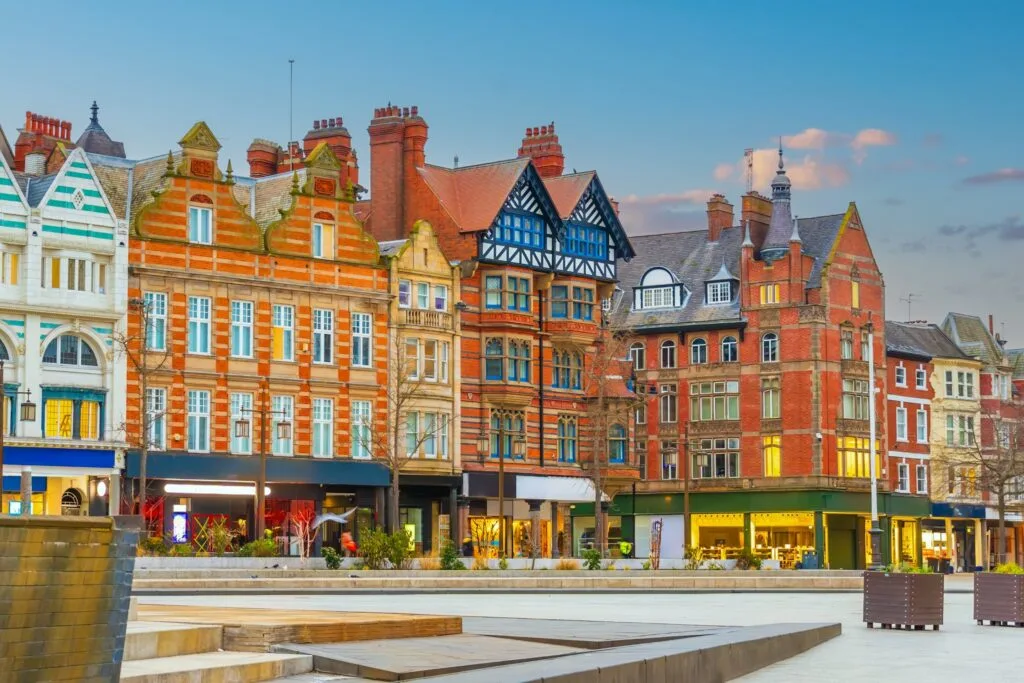


There is only so long anyone can work at the same desk before the walls start closing in. Nottingham is a good city for changing scene: it has two large university library networks, a compact centre you can cross in twenty minutes, a strong independent café culture, and plenty of quiet corners that most students never think to try. This guide runs through the best study spots in Nottingham, what each one is actually good for, and when to use them, so you can match the place to the task rather than defaulting to whichever café is nearest.
In short: use the university libraries for deep work and deadlines, independent cafés for lighter reading and group sessions, the city’s public libraries and museums when you want quiet without a queue, and your own accommodation’s study rooms when you want no commute at all.
University libraries
Both universities run library networks that stay open long hours in term time, and for focused work they are hard to beat. The University of Nottingham’s Hallward Library on University Park is the main humanities and social sciences site, with the George Green Library covering science and engineering, and the Business Library on Jubilee Campus serving that side of the university. Nottingham Trent’s Boots Library sits on the City Campus and is the one most central students default to, with the Clifton and Brackenhurst campuses running their own.
The advantage of a university library is not just silence: it is the culture. Everyone around you is working, the desks are built for long sessions, the Wi-Fi is reliable, and you have access to the physical and digital collections you actually need. The trade-off is competition for space during assessment periods, when seats disappear early and stay taken. If you are heading in during exam season, go early or use the seat-booking systems both universities run.
Best for: deep focus, dissertation work, anything with a deadline attached.

Independent cafés
Nottingham has a genuinely good independent café scene, and it is spread across the areas students actually live in. The Lace Market and Hockley are the obvious hunting grounds, with a cluster of independents serving decent coffee in rooms designed for sitting rather than turning tables over. Sneinton Market has become a creative quarter with a handful of cafés attached to studios and galleries. Around Lenton and Beeston you will find quieter neighbourhood places that fill with students in the afternoon but rarely feel crowded.
A few practical points. Ask before you settle in for four hours, and buy something roughly every ninety minutes — most independents are relaxed about laptops but they are running a business. Check for plug sockets before you commit to a table. And be honest about what café noise does to your concentration: background chatter suits reading, note-taking and planning far better than it suits writing or problem sets.
Best for: reading, planning, group work, and the kind of task that benefits from a bit of ambient noise.
Public libraries and civic spaces
Nottingham Central Library moved into its new home on Carrington Street, next to the Broadmarsh site, and it is a genuinely good study space that far fewer students use than should. It is free, quiet, centrally located, and open to everyone — no student card required. The city’s branch libraries in Beeston, West Bridgford and elsewhere are smaller but similarly underused during the day.
Beyond libraries, Nottingham Contemporary has a café and public seating areas that work well for lighter work, and the New Art Exchange in Hyson Green is another spot with room to sit. Museums and galleries tend to be quiet on weekday mornings.
Best for: quiet work when the university libraries are full, and for anyone who wants a change of scene without paying for it.
Green spaces and outdoor study
On the handful of genuinely warm days Nottingham gets, the Arboretum is the closest proper park to the city centre and NTU, with benches and open lawn. University Park’s campus grounds are among the most attractive of any UK university and there is no shortage of places to sit. Wollaton Park, a little further out, is worth the trip on a good day. Highfields Park sits opposite University Park and is quieter than the campus itself.
Outdoor study is better for reading and thinking than for anything requiring a screen — glare and battery life see to that. Take paper.
Best for: reading, revision by hand, and clearing your head between sessions.

Studying in your accommodation
The study space you use most is the one you do not have to travel to. Purpose-built student accommodation increasingly includes dedicated study rooms precisely because a bedroom desk is not a great place to work for eight hours, and because kitchens and lounges are too social for focused work.
The advantage is obvious in February, when the walk to campus in the rain is the thing standing between you and starting. A study room in your own building removes the friction entirely, and if it is open around the clock it also covers the late-night stretches when the university libraries have closed.
Best for: early mornings, late nights, bad weather, and any day when the barrier to working is simply getting out of the door.
How to choose the right spot for the task
Match the place to the work rather than to the mood. Deep, difficult work that needs sustained concentration belongs in a library — the silence and the surrounding focus do real work for you. Reading, planning and admin survive café noise perfectly well and often benefit from it. Group work needs somewhere you can talk without annoying anyone, which rules out silent library floors and points towards bookable study rooms or a café with a large table.
Two practical habits make a bigger difference than the venue itself: decide what you are going to do before you arrive, and give yourself a finish time. A well-chosen café with no plan is less productive than a mediocre desk with one.
Where Study Inn fits in Nottingham
Study Inn has two properties in Nottingham. Talbot Street sits in the city centre, a 1-minute walk from Nottingham Trent University’s City Campus, with the University of Nottingham reachable in 11 minutes by bus or 13 minutes by bike. Triumph House sits on Triumph Road, within the University of Nottingham’s Jubilee Campus, so campus is a 1-minute walk; Nottingham Trent’s City Campus is 11 minutes away by bus or bike.
Both have dedicated study rooms on site, so there is somewhere to work that is not your bedroom and not a twenty-minute walk away. Everything is all-inclusive, covering utility bills, superfast Wi-Fi, 24/7 staff on site, postal service, regular social events and maintenance, with no damage deposit and no UK guarantor required. Residents also have access to a fully equipped gymnasium, a wellness spa with sauna, steam room and hot beds, and an entertainment area, with a dedicated housekeeper, bedroom cleaning, fresh towels and linen, a concierge and parcel collection service and a Smart TV in every bedroom. Talbot Street adds a yoga studio, and Triumph House a basketball court and garden. Triumph House won the Student Voice Top Rankings in Nottingham in 2025, and Study Inn was named Best Student Accommodation Operator at the RESI Awards 2026, as well as winning awards for Best Student Experience in Accommodation, Best Resident Wellbeing Programme in Europe and Best Student Broadband in the UK.
Frequently Asked Questions
Where are the best places to study in Nottingham?
For focused work, the university libraries are the strongest option: Hallward and George Green at the University of Nottingham, and the Boots Library at Nottingham Trent’s City Campus. For a change of scene, the independent cafés around Hockley, the Lace Market and Sneinton Market work well, and Nottingham Central Library on Carrington Street is free, quiet and underused.
Are Nottingham’s university libraries open to everyone?
They are primarily for enrolled students and staff, and access during busy assessment periods is usually restricted to that university’s own students. Nottingham Central Library and the city’s branch libraries are open to everyone with no student card required.
Can you study in cafés in Nottingham?
Yes, and most independents are relaxed about it. Buy something regularly, avoid the lunchtime rush if you plan to stay a while, and check for plug sockets before settling in. Cafés suit reading, planning and group work better than tasks needing deep concentration.
Where can I study late at night in Nottingham?
University libraries extend their hours during assessment periods, and some offer 24-hour access at peak times. Outside those periods, accommodation with its own study rooms is usually the most reliable option for late-night work, since it does not depend on opening hours or a journey home afterwards.
Is it better to study at home or go out?
It depends on the task and on you. Working at home removes travel time and is the more realistic option in bad weather, but it needs a proper desk and a space that is not also where you relax. Going out creates a clearer boundary between working and not working, which many students find easier to sustain. Accommodation with dedicated study rooms offers a middle ground: a separate space to work without leaving the building.